
How It Works, What Pests It Detects and Controls, and How It Closes the Final Gap in Pest Control Programs
1. What Is the Sewer Assassin Clean-Out Station?
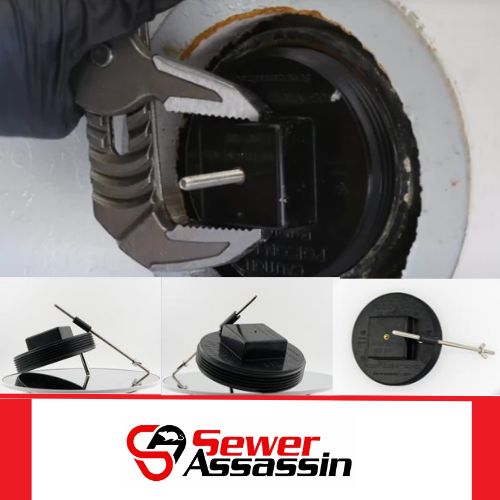
The Sewer Assassin® rodent bait Station is a specialized pest monitoring and control system designed to help pest management professionals address pest activity within underground plumbing and sewer lines.
Traditional pest control programs focus on accessible areas of a property, including foundations, exterior walls, doors, windows, attics, crawl spaces, and interior spaces.
However, one major pathway is frequently overlooked: the plumbing system.
Sewer lines can provide travel routes and harborage for rodents, American cockroaches, and drain flies. When plumbing systems develop cracks, broken connections, deteriorated seals, or other openings, these pests may gain access to the building.
The Sewer Assassin helps bridge that gap by allowing pest professionals to monitor and control activity directly within the plumbing system.
Key Features
- Designed for 3-inch and 4-inch plumbing clean-outs.
- Replaces a conventional clean-out cap.
- Provides access for monitoring and pest control.
- Supports multiple monitoring and treatment methods.
- Can be used in residential and commercial applications.
- Offers configurations for in-ground and in-wall clean-outs.
- Allows technicians to service monitoring and treatment materials without repeatedly removing the entire clean-out cap.
2. Exactly How the Sewer Assassin Works
The Sewer Assassin converts an existing plumbing clean-out into a pest monitoring and treatment access point.
Step 1: Identify the Clean-Out Location
The technician locates an accessible plumbing clean-out connected to the building’s sewer system.
Clean-outs are commonly found:
- Outside residential foundations.
- Near commercial buildings.
- In landscaping or underground utility access areas.
- Inside mechanical rooms.
- Within walls or other accessible plumbing locations.
Step 2: Install the Sewer Assassin
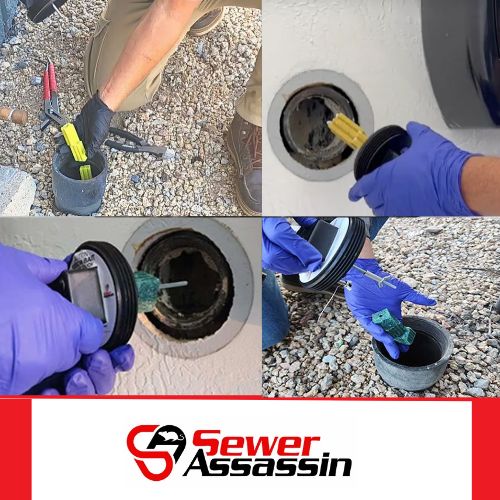
The existing clean-out cap is removed and replaced with the appropriately sized Sewer Assassin station.
Depending on the installation, the station uses a threaded rod or wire assembly to position monitoring or treatment materials inside the plumbing.
The clean-out continues to function as a plumbing access point while also serving as a pest monitoring and control station.
Step 3: Deploy Monitoring or Treatment Materials
The technician selects the appropriate monitoring or treatment method based on the pest being investigated.
Options include:
- Non-toxic rodent monitoring blocks.
- Sewer-labeled rodenticides.
- Insect monitoring boards.
- Appropriately labeled cockroach gel baits.
- Approved insecticidal dust formulations.
- Nuvan ProStrips installed with the Sewer Assassin Pest Strip Holder where label-permitted.
Step 4: Inspect and Monitor Activity
Technicians return to inspect the materials and determine whether pests are active inside the plumbing.
Findings may include:
- Rodent feeding on monitoring blocks.
- Rodenticide consumption.
- Cockroaches captured on monitoring boards.
- Drain flies captured on monitoring boards.
- Changes in pest activity following treatment.
Step 5: Implement Ongoing Control
When activity is confirmed, the technician can select an appropriate treatment strategy.
The Sewer Assassin can then become part of an ongoing integrated pest management program.
Instead of repeatedly treating pests after they appear inside the building, technicians gain an additional opportunity to address activity in the plumbing.
3. What Pests Can Sewer Assassin Detect and Control?
The three primary pest groups addressed by the system are rodents, American cockroaches, and drain flies.
Pest | Detection method | Control method |
Rats and other rodents | Non-toxic Detex monitoring blocks | Appropriately labeled sewer rodenticides |
American cockroaches | Adhesive monitoring boards | Approved gel baits, dusts, or vapor strips |
Drain flies | Adhesive monitoring boards | Approved adult insect treatments, along with breeding-source removal |
Each pest requires a different strategy.

4. Rodent Detection and Control
Rats are among the most challenging pests associated with underground sewer systems.
Norway rats, in particular, are well adapted to sewer environments. They can travel through pipes and underground infrastructure in search of food, water, and shelter.
Method 1: Non-Toxic Rodent Monitoring with Detex
One of the most useful applications of the Sewer Assassin is deploying non-toxic Detex monitoring blocks.
How it works:
- A technician installs a Sewer Assassin station at an appropriate clean-out.
- A non-toxic Detex monitoring block is secured to the station.
- The monitoring block is suspended inside the plumbing system.
- Rodents traveling through the line may encounter and gnaw on the block.
- The technician inspects the block for feeding activity during follow-up service.
What this tells the technician:
Evidence of feeding supports the conclusion that rodents are active within that section of the plumbing system.
This is particularly valuable when a building experiences recurring rodent activity despite extensive exterior exclusion efforts.
For example, a restaurant may have sealed exterior openings, installed rodent stations, and maintained excellent sanitation.
However, rodents continue appearing inside.
The Sewer Assassin provides a way to investigate whether the sewer system is contributing to the problem.
Method 2: Rodent Control with Sewer-Labeled Rodenticides
When monitoring confirms rodent activity, a pest professional may use an appropriate rodenticide specifically labeled for the application.
How it works:
- A sewer-labeled rodenticide is secured to the station according to its label.
- The material is positioned within the plumbing.
- Rodents traveling through the line may feed on the bait.
- The technician monitors bait consumption and activity.
- Treatments and inspections continue as permitted and needed.
Why this is different from traditional rodent control:
Conventional rodent programs often place bait stations around building exteriors or in approved interior locations.
However, those stations may never intercept rodents traveling exclusively through underground plumbing.
Sewer Assassin adds a control point directly within the suspected travel route.
Method 3: Ongoing Rodent Monitoring
Once activity decreases, the station can be maintained as part of a long-term monitoring program.
This allows pest management professionals to detect renewed activity before it develops into another major infestation.
Important: Not every rodenticide is approved for sewer use. Product selection, placement, inspection, and disposal must follow the applicable label and regulations.
5. American Cockroach Detection and Control
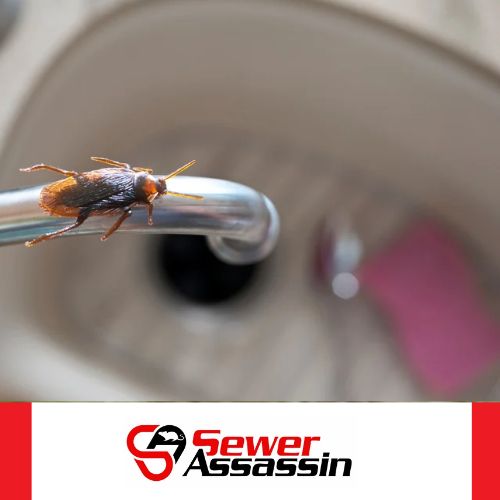
American cockroaches are commonly associated with sewer systems, underground infrastructure, and other warm, humid environments.
They can move through plumbing networks and potentially enter structures through openings, defective connections, and compromised plumbing components.
The Sewer Assassin provides several approaches to detection and control.
Method 1: Cockroach Monitoring Boards
The station can suspend an adhesive insect monitoring board inside an accessible plumbing line.
How it works:
- The technician attaches a monitoring board to the station’s mounting assembly.
- The board is positioned in the plumbing.
- Cockroaches traveling through the area may contact the adhesive.
- Captured insects provide evidence of activity.
- The technician uses the findings to evaluate treatment needs.
This provides an additional diagnostic option when cockroaches repeatedly appear in areas such as bathrooms, kitchens, utility rooms, and commercial facilities.
Method 2: Gel Bait Applications
The station’s access design may allow appropriate gel baits to be applied to accessible, label-approved areas.
Gel baits are intended to attract cockroaches and deliver an insecticidal treatment when consumed.
Targeting the plumbing environment can supplement traditional interior cockroach control.
Method 3: Insecticidal Dust Applications
Where the pesticide label permits sewer or drain treatment, the access port may support an appropriate dust application.
Dust treatments may help target cockroaches using inaccessible plumbing areas.
Application techniques must be compatible with the station, the plumbing system, and the product label.
Method 4: Nuvan ProStrips with the Pest Strip Holder
The Sewer Assassin Pest Strip Holder is designed to hold a 16-gram Nuvan ProStrip.
Nuvan ProStrips contain dichlorvos, an insecticide that releases vapor into a treated space.
Where expressly permitted by the product label, this approach can target susceptible insects occupying an enclosed treatment area.
Why this matters:
Traditional cockroach treatments often focus on areas where cockroaches become visible.
Sewer Assassin gives professionals a way to investigate and, where permitted, treat their activity inside the plumbing system.
Vapor strips must not be deployed in sewer lines unless the specific product label explicitly authorizes that use. The presence of a compatible holder does not by itself establish that a pesticide application is legally permitted.
6. Drain Fly Detection and Control
Drain flies are common problems in restaurants, commercial kitchens, food-processing facilities, and buildings with extensive drainage systems.
Their larvae develop in moist organic material, including buildup inside drains and plumbing.
Method 1: Drain Fly Monitoring Boards
Adhesive monitoring boards can be positioned inside a clean-out station to capture adult drain flies.
How it works:
- The technician installs an insect monitoring board.
- The board is positioned inside the plumbing.
- Adult drain flies traveling through the area may become trapped.
- The technician inspects the board during follow-up service.
- Findings help determine whether the plumbing line is associated with fly activity.
This is especially helpful when customers report continued fly activity despite routine drain cleaning.
Method 2: Approved Insecticide Treatments
Where specifically authorized by the applicable product label, compatible insecticide treatments may be considered to suppress susceptible adult insects.
A properly authorized vapor-strip application may be one option, but approval must be verified for the exact location and installation.
Method 3: Identifying Persistent Breeding Sources
Drain fly control requires more than killing adult insects.
If organic buildup remains inside plumbing lines, new flies can continue emerging.
The Sewer Assassin can help monitor adult activity, while plumbers and pest management professionals investigate and correct breeding conditions.
The advantage: The station offers an additional monitoring and potential control point for drain fly problems associated with underground or otherwise inaccessible plumbing.
7. How Sewer Assassin Closes the Final Gap in Traditional Pest Control Programs
Most integrated pest management programs include several important components.
Traditional Pest Control
- Inspection: Identify pest activity and potential entry points.
- Population reduction: Use appropriate traps, baits, and other treatments.
- Exclusion: Seal exterior openings and structural gaps.
- Sanitation: Remove food, water, and harborage conditions.
- Monitoring: Check for recurring pest activity.
These are essential practices.
However, the plumbing system may remain unexamined.
The Missing Piece: Underground Plumbing
A building can have excellent exterior exclusion and still experience pest problems if plumbing defects create another entry route.
Examples include:
- Cracked underground sewer pipes.
- Broken plumbing fittings.
- Deteriorated pipe connections.
- Open or abandoned plumbing lines.
- Damaged clean-outs.
- Compromised drain connections.
- Other openings connecting sewer lines to building interiors.
Traditional exterior rodent stations and interior insect treatments may not address pest populations living and traveling inside these underground systems.
The Sewer Assassin Solution
By incorporating plumbing monitoring and appropriate control into the pest management program, technicians can address a previously overlooked environment.
Traditional IPM | IPM with Sewer Assassin |
Exterior rodent stations | Exterior stations plus plumbing monitoring |
Interior cockroach treatments | Interior treatments plus investigation of sewer activity |
Drain cleaning and sanitation | Drain maintenance plus plumbing fly monitoring |
Structural exclusion | Structural exclusion plus plumbing defect investigation |
Monitoring accessible areas | Monitoring accessible areas and selected sewer lines |
Reacting to recurring activity | Investigating potential underground sources |
The key distinction: Sewer Assassin does not replace exclusion, sanitation, trapping, or conventional pest control. It extends the program into the plumbing system.
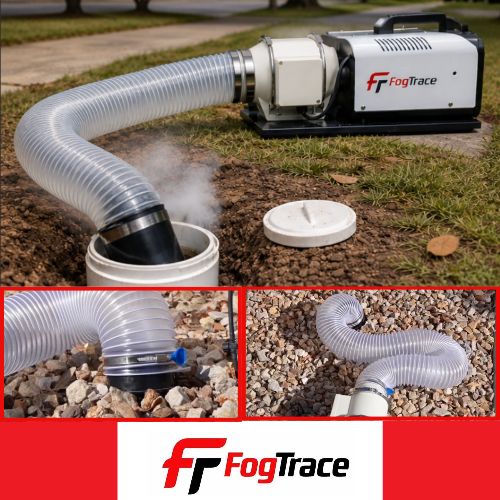
8. Combining Sewer Assassin with FogTrace™ Smoke Testing
The Sewer Assassin can help answer an important question:
Are pests active inside the plumbing system?
But that leads to another question:
How are they getting from the plumbing into the building?
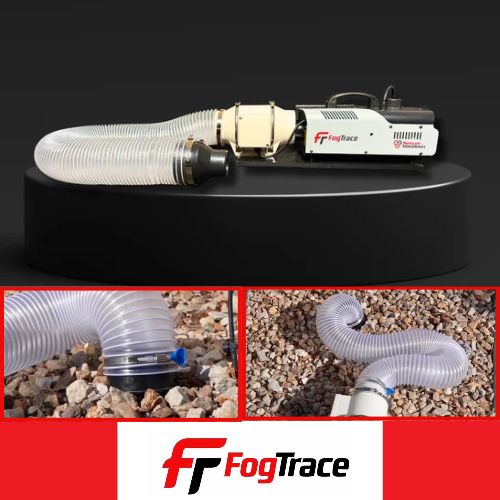
This is where FogTrace sewer smoke test machine can become an important diagnostic tool.
Step 1: Detect Pest Activity
Install Sewer Assassin monitoring materials to determine whether rodents or insects are active inside the plumbing.
For example, a technician discovers rodent gnawing on a non-toxic monitoring block.
That supports the presence of rodent activity within the monitored line.
Step 2: Evaluate the Plumbing System
If pests are also appearing inside the structure, investigate possible entry points.
The technician may recommend a plumbing inspection or smoke test.
Step 3: Use FogTrace to Identify Openings
FogTrace sewer smoke test machine introduces dense, water-based fog into the plumbing system during a controlled smoke test.
Fog escaping through unintended locations may reveal defects such as:
- Cracked pipes.
- Disconnected plumbing.
- Failed seals.
- Broken fittings.
- Abandoned or improperly capped connections.
These defects may create pathways for sewer-based pests to enter a building.
Step 4: Repair the Plumbing Defects
Once the openings are identified, a qualified plumbing professional can make the necessary repairs.
This is critical because treating pests without addressing an active entry point may allow the problem to return.
Step 5: Continue Monitoring
Following repairs and initial control, the Sewer Assassin can remain part of the pest monitoring program.
This allows technicians to monitor ongoing sewer activity and identify potential problems.
The Complete Approach
Detect → Monitor → Control → Locate → Repair → Maintain
Together, Sewer Assassin and FogTrace smoke test machine support a more comprehensive strategy for identifying sewer pest activity, investigating potential entry pathways, and reducing recurring pest problems.
9. Why Sewer Assassin Is Valuable for Pest Control Companies
Reduces Recurring Pest Problems
Recurring infestations can occur when technicians treat visible pest activity without identifying its source.
Sewer Assassin gives professionals another diagnostic and control option when conventional programs are not producing lasting results.
Expands Pest Control Services
Companies can potentially introduce specialized services such as:
- Sewer rodent monitoring.
- Sewer rodent control.
- American cockroach monitoring.
- Drain fly monitoring.
- Plumbing-related pest investigations.
- Ongoing clean-out station maintenance.
Creates Recurring Service Opportunities
Once a Sewer Assassin station is installed, technicians can incorporate inspections and monitoring into routine service visits.
This creates the opportunity for an additional recurring service, particularly for commercial accounts.
Improves Commercial Pest Management Programs
Potential applications include restaurants, commercial kitchens, warehouses, food-processing facilities, apartment buildings, hotels, and other structures with recurring plumbing-related pest problems.
Helps Identify Problems That Traditional Treatments May Miss
Evidence collected from inside the plumbing can help technicians make better-informed recommendations.
It can also support collaboration between pest management professionals and plumbing contractors.
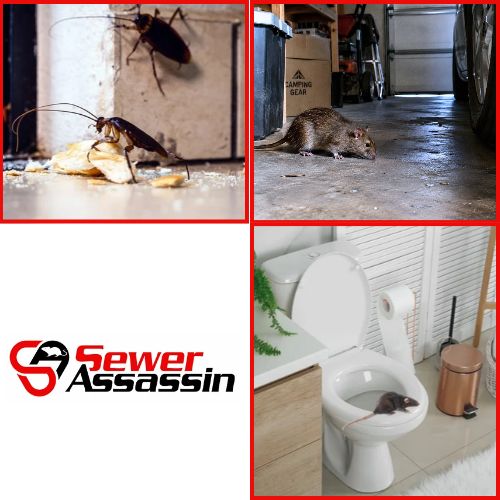
10. Example: A Restaurant with Recurring Pest Problems
Consider a restaurant experiencing repeated American cockroach activity.
The pest control company has already:
- Treated cracks and crevices.
- Applied approved cockroach baits.
- Addressed sanitation issues.
- Sealed visible structural openings.
- Conducted routine inspections.
Despite these efforts, cockroaches continue appearing.
Adding Sewer Assassin
First: The technician installs Sewer Assassin stations at appropriate clean-out locations and deploys insect monitoring boards.
Second: The technician inspects the boards and discovers American cockroach activity within the sewer line.
Third: The company develops a targeted control strategy using treatments specifically approved for the application.
Fourth: If the building continues experiencing interior activity, a FogTrace smoke test can help identify plumbing defects that may be contributing to the problem.
Fifth: A plumber repairs confirmed defects, while the pest management company continues monitoring and appropriate treatments.
The Result
The pest management program now addresses both the visible infestation and a potential underground source.
Rather than repeatedly treating the same symptoms, the company has additional information and tools to investigate why the infestation keeps returning.
This approach can improve the chances of achieving longer-lasting control, although results depend on the actual pest source, plumbing condition, and corrective work performed.
11. The Long-Term Benefits of Sewer Assassin
Benefit | Value to the pest control company |
Plumbing pest detection | Identifies activity that may otherwise go unnoticed |
Targeted rodent control | Addresses rodents traveling through sewer lines |
Cockroach monitoring and treatment | Adds an option for investigating sewer-origin populations |
Drain fly monitoring | Helps investigate persistent plumbing-associated fly activity |
Reduced repeat infestations | Supports source-based pest control rather than repeated symptom treatment |
Recurring maintenance | Creates opportunities for additional service revenue |
FogTrace integration | Helps investigate possible plumbing entry points |
More complete IPM | Extends pest management into previously overlooked underground systems |
12. Closing the Final Gap in Pest Control
Pest management professionals work hard to identify pests, eliminate infestations, seal structural entry points, improve sanitation, and provide lasting protection.
But even a comprehensive program can leave one area unaddressed: the plumbing system.
Underground sewer lines can provide concealed pathways for rodents, American cockroaches, and drain flies. If those pests are traveling through plumbing, conventional treatments may never reach the source of the activity.
The Sewer Assassin Clean-Out Station provides pest professionals with another way to detect, monitor, and control sewer-based pests.
When combined with FogTrace smoke testing and appropriate plumbing repairs, it becomes part of a broader strategy to address both pest populations and potential entry points.
The Sewer Assassin Difference
Traditional pest control protects the building from the outside and the inside. Sewer Assassin extends that protection into the plumbing system.
It gives pest professionals an additional layer of monitoring, control, and diagnostic capability that helps close one of the final gaps in comprehensive pest management programs.
Sewer Assassin® — Close the Final Gap in Pest Control.
Visit SewerAssassin.com to learn more about the Sewer Assassin Clean-Out Station and FogTrace plumbing smoke testing solutions.
Sewer Assassin® Clean-Out Station: How It Works for Sewer Pest Detection and Control
Frequently Asked Questions
1. What is the Sewer Assassin® Clean-Out Station?
The Sewer Assassin® Clean-Out Station is a pest monitoring and control system designed for 3-inch and 4-inch plumbing clean-outs. It helps pest control professionals detect, monitor, and manage rodents and insects traveling through underground sewer lines.
2. What pests can the Sewer Assassin Clean-Out Station detect and control?
The Sewer Assassin is designed to help monitor and manage rats, American cockroaches, and drain flies. Pest management professionals can use monitoring blocks, insect monitoring boards, and appropriately labeled treatments to address activity inside plumbing systems.
3. How does the Sewer Assassin Clean-Out Station work?
The Sewer Assassin replaces an existing plumbing clean-out cap and provides access for placing pest monitoring or treatment materials inside sewer lines. Technicians can inspect these materials during routine service visits to identify pest activity and determine whether additional treatment is needed.
4. Can Sewer Assassin help prevent recurring rodent and cockroach infestations?
Yes. Sewer Assassin can help pest control professionals investigate recurring infestations by monitoring pest activity inside plumbing systems. When combined with proper exclusion, sanitation, approved treatments, and plumbing repairs, it can support more effective long-term pest management.
5. Can Sewer Assassin be used with FogTrace™ sewer smoke testing?
Yes. Sewer Assassin helps detect pest activity inside sewer lines, while FogTrace™ smoke testing helps identify plumbing defects that may allow pests to enter buildings. Together, these tools support a more comprehensive approach to sewer pest detection, entry-point investigation, and control.
Learn More: Visit SewerAssassin.com to explore the Sewer Assassin® Clean-Out Station and FogTrace™ smoke testing solutions.